For many home care agencies, Electronic Visit Verification (EVV) started as one more compliance requirement on an already long list. The focus was simple: avoid penalties, prove that visits happened, and keep payers satisfied.
But when EVV is treated only as a checkbox, it often creates more friction than clarity. Caregivers feel watched instead of supported, coordinators wrestle with multiple systems, and billing teams still chase missing data at the end of each pay period.
The reality is that EVV can do much more than prove that a visit took place. When it is integrated into a clear EVV home care workflow, it becomes the backbone of your home care operations management: giving you real-time visibility into visits, cleaner documentation, and faster, more accurate billing.
In this article, we’ll look at how EVV—paired with the right EVV compliance software—can help your home care agency move from “we must comply” to “we finally see what’s happening across our entire field team.”

The Hidden Cost of Treating EVV as “Just Compliance”
Before EVV became part of daily operations, many agencies already struggled with:
-
Schedules changing at the last minute
-
Missed or late visits that only surfaced at payroll
-
Incomplete or inconsistent visit notes
-
Claims rejected because key visit data was missing
-
Constant calls, texts, and emails to confirm where people were
When EVV is added as a stand-alone app or manual process, it can actually amplify these problems. Caregivers clock in and out, but the data doesn’t talk to scheduling, documentation, or billing. Operations teams still need to reconcile everything by hand.
The real value of EVV appears when it becomes part of a fully mapped, digital workflow—from booking to billing. If you want to dive deeper into how this looks in practice, you can explore our article on EVV-ready workflows from home care booking to billing.
What an EVV Home Care Workflow Should Look Like
A well-designed EVV home care workflow doesn’t start when the caregiver arrives at the door. It starts much earlier and continues until the visit is fully billed and paid.
Here’s how a streamlined flow can look:
1. Intake and Service Setup
-
Client information and service authorizations are captured once in your system.
-
Service types, payers, and required EVV fields are configured centrally.
-
Rules are set so that only authorized services can be scheduled and delivered.
This reduces errors from the start and gives your team one source of truth.
2. Smart Scheduling With Built-In EVV Rules
-
Coordinators schedule visits based on availability, geography, and authorizations.
-
The system automatically checks for conflicts or over-scheduling.
-
EVV requirements are embedded, so every scheduled visit is ready for verification.
For broader strategies on structuring your home care schedules and team, see our article on home care agency management software.
3. Mobile Check-In and Check-Out
-
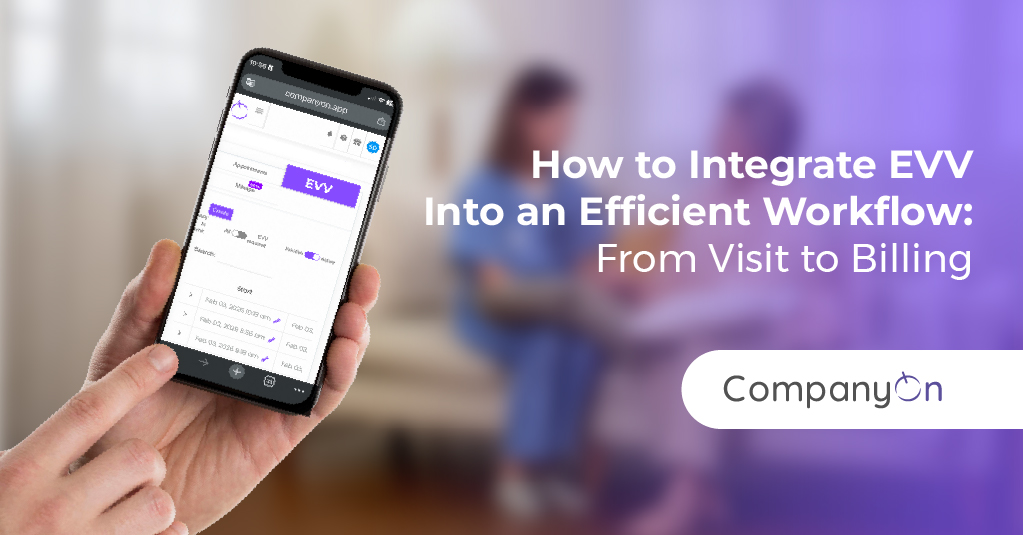
Caregivers use a mobile app to start and end visits at the client’s location.
-
Time, location, and caregiver identity are captured automatically.
-
Task lists or care plans for that visit are available in the same app.
This simplifies the caregiver’s day and ensures the visit record is complete.
4. Real-Time Visibility for Coordinators
-
Office staff can see which visits are in progress, completed, late, or missed.
-
Alerts flag exceptions, such as no check-in or early departures.
-
Coordinators can respond quickly to scheduling gaps or potential service failures.
For teams managing multiple caregivers on the road, tools like route optimization for community care and our digital playbook for managing small home nursing teams can add even more efficiency.
5. Documentation Tied to Each EVV Record
-
Care notes, tasks completed, and client signatures are attached to the same visit entry.
-
Documentation requirements are standardized and prompts ensure nothing is missed.
-
Everything is stored digitally and is easy to retrieve for audits or quality reviews.
You can see practical recommendations for this in our guide on documentation best practices for mobile home visits.
6. Billing and Payroll That Practically Run Themselves
-
Only verified, completed visits flow into billing.
-
Payer-specific rules are applied automatically to reduce rejections.
-
Payroll is generated from EVV-verified time, reducing disputes and manual adjustments.
When EVV, scheduling, and billing are connected, you move from reactive clean-up work to proactive management of your revenue cycle.
From Compliance to Clarity in Home Care Operations Management
Once EVV is integrated into your daily operations, you stop looking at it as a surveillance tool and start using it as a management tool.
A good home care operations management setup with EVV at its core allows you to:
-
Monitor visit completion rates and on-time performance
-
See which routes or time slots frequently cause delays
-
Identify training needs based on repeated documentation issues
-
Track service mix and visit volumes by geography, client type, or payer
When you track the right metrics, EVV data becomes a powerful source of insight. If you want to go further, our article on KPIs for home care agencies explains which numbers actually help you make better decisions.
What to Look For in EVV Compliance Software
Not all EVV compliance software is created equal. Choosing the wrong tool can lock you into rigid workflows or force your team to juggle multiple disconnected apps.
When evaluating options, look for:
-
All-in-one workflows
EVV should be integrated with scheduling, documentation, and billing—not bolted on. This reduces duplicate data entry and keeps everyone working from the same information. -
Mobile-first experience for caregivers
The app should be simple, fast, and intuitive. If it slows caregivers down, adoption will suffer. -
Configurable rules for different payers and programs
You should be able to adapt EVV rules to your contracts, not redesign your services to fit the software. -
Real-time dashboards and alerts
Operations managers need visibility into what is happening now, not just reports at the end of the month. -
Audit-ready documentation
Every visit should have a clear, digital trail—time, location, caregiver, services provided, and notes—ready for any audit. -
Support for a mobile, growing team
If your team is expanding, your EVV solution should make it easier to manage more caregivers, more visits, and more complex routes. Our guide on automating staff commissions in home care shows how the right digital tools remove friction as you grow.
How CompanyOn Turns EVV Into a Growth Tool for Home Care Agencies
At CompanyOn, we designed our platform so that EVV is not an isolated requirement—it is part of a connected, digital system that supports your entire home care operation.
With CompanyOn you can:
-
Build EVV-ready workflows from booking to billing in a single place.
-
Schedule visits, manage routes, and support mobile teams using tools like clients route map and route optimization for community care.
-
Capture EVV, documentation, and client consent in a consistent, audit-ready way, supported by best practices from our article on documentation for mobile home visits.
-
Automate billing and staff compensation so you can grow without more spreadsheets, as we explain in automating staff commissions in home care.
-
Run more and more of your operations from your phone or tablet, guided by our resource on running your entire healthcare practice from your phone.
If you are still learning the fundamentals, you can start with our overview on what EVV is and why it matters to your practice and then move into our focused article on EVV in home care and what agencies need to get right in 2026.
Final Thoughts: EVV as a Catalyst for Better Care
EVV doesn’t have to be a burden or a box to tick. When it is part of a thoughtful EVV home care workflow, supported by the right EVV compliance software, it becomes a powerful source of clarity:
-
You know who was where, when, and what care was delivered.
-
Your team spends less time chasing missing information.
-
Your billing is cleaner, faster, and more predictable.
-
Your clients and their families gain confidence in the reliability of your service.
And as you move from solo provider to growing home care agency, having these systems in place before you hire your next team member is critical. For help planning that transition, explore our guide on moving from solo nurse to small home care agency.
If you’re ready to turn EVV from a compliance headache into a strategic advantage, CompanyOn is here to help you design a simpler, clearer way to run your home care operations.
Ready to make the switch?
Try Our Platform Free for 14 days.
See CompanyOn in Action
Schedule A Free 1:1 Personalized Demo