
A daughter calls on Tuesday afternoon. Her father is being discharged from hospital on Thursday, he cannot manage stairs yet, and she lives two hours away. She calls three agencies. One sends her to voicemail, one promises a call back “early next week,” and one asks a few clear questions, books an assessment for Wednesday morning and has a caregiver at the door when her father gets home. Guess which agency gets the client. In home care, intake speed is often the deciding factor, and most families choose the agency that makes the next step feel easy.
The short answer: a fast home care client intake follows five steps: a structured first call, an in-home or virtual assessment within 24 hours, a draft care plan, a matched caregiver assignment, and a confirmed first visit. With a standard intake form, clear ownership of each step and one system for records, scheduling and documentation, most agencies can move from first call to first visit in about 48 hours without cutting corners on safety.
Why intake speed matters
Families rarely shop for home care months in advance. The call usually comes after a fall, a hospital discharge, a new diagnosis or a caregiver who can no longer cope. They need help quickly, and they will keep calling agencies until someone gives them a clear plan.
A slow or disorganized intake costs you twice. You lose clients to faster competitors, and the clients you do win start with gaps: missing medical details, unclear expectations and a first visit that feels improvised. Those early gaps are one of the reasons agencies see clients leave soon after starting, a pattern we unpack in why home care agencies lose patients after the first month. A good intake fixes both problems at once: it is fast, and it is thorough.
The 48-hour intake checklist

Use these five steps as your standard workflow. Assign one owner to each, and track every new inquiry until the first visit is complete.
1. The first call (hour 0)
Answer live whenever possible, and return every missed inquiry within the hour. Use a short, structured intake script so nothing depends on memory:
- Who needs care, where they live and who is calling
- What happened, and why they are calling now
- Care needs in broad terms: personal care, mobility, meals, companionship, nursing
- Preferred start date, days and hours
- How care will be paid: private pay, long-term care insurance, or a public program (provincial home care, Medicaid, veterans’ benefits)
- Any urgent safety concerns
End the call with a specific next step and time: “Our coordinator will be at your father’s home tomorrow at 10 a.m.” Families relax when they hear a date, not a promise.
2. The assessment (within 24 hours)
Visit the home, or do a video assessment when distance or timing requires it. Confirm the client’s health summary, mobility, cognition, home safety, routines and preferences, and meet the family decision-maker. Collect consent, privacy acknowledgements and service agreements during the same visit so you are not chasing signatures later. For publicly funded clients, confirm the authorized hours and services before you schedule.
3. The draft care plan (within 30 hours)
Turn the assessment into a clear, person-centred plan: goals, tasks per visit, risks, preferences and escalation steps. It does not need to be perfect on day one, but it must be specific enough for a caregiver who has never met the client. Our guide to writing and sharing home care care plans walks through what to include.
4. Caregiver assignment (within 36 hours)
Match the client to a caregiver based on skills, availability, location, language and personality, not just whoever has an open slot. Brief the caregiver on the care plan before the visit, and line up a backup in case of a call-out.
5. The first visit (within 48 hours)
Confirm the visit with the family the day before. Where possible, have a coordinator or supervisor introduce the caregiver, or call the family during the first visit. Ask the caregiver to record detailed notes, and call the family within 24 hours afterward to check that everything matched their expectations. Adjust the care plan based on what you learn.
What to capture on your home care intake form
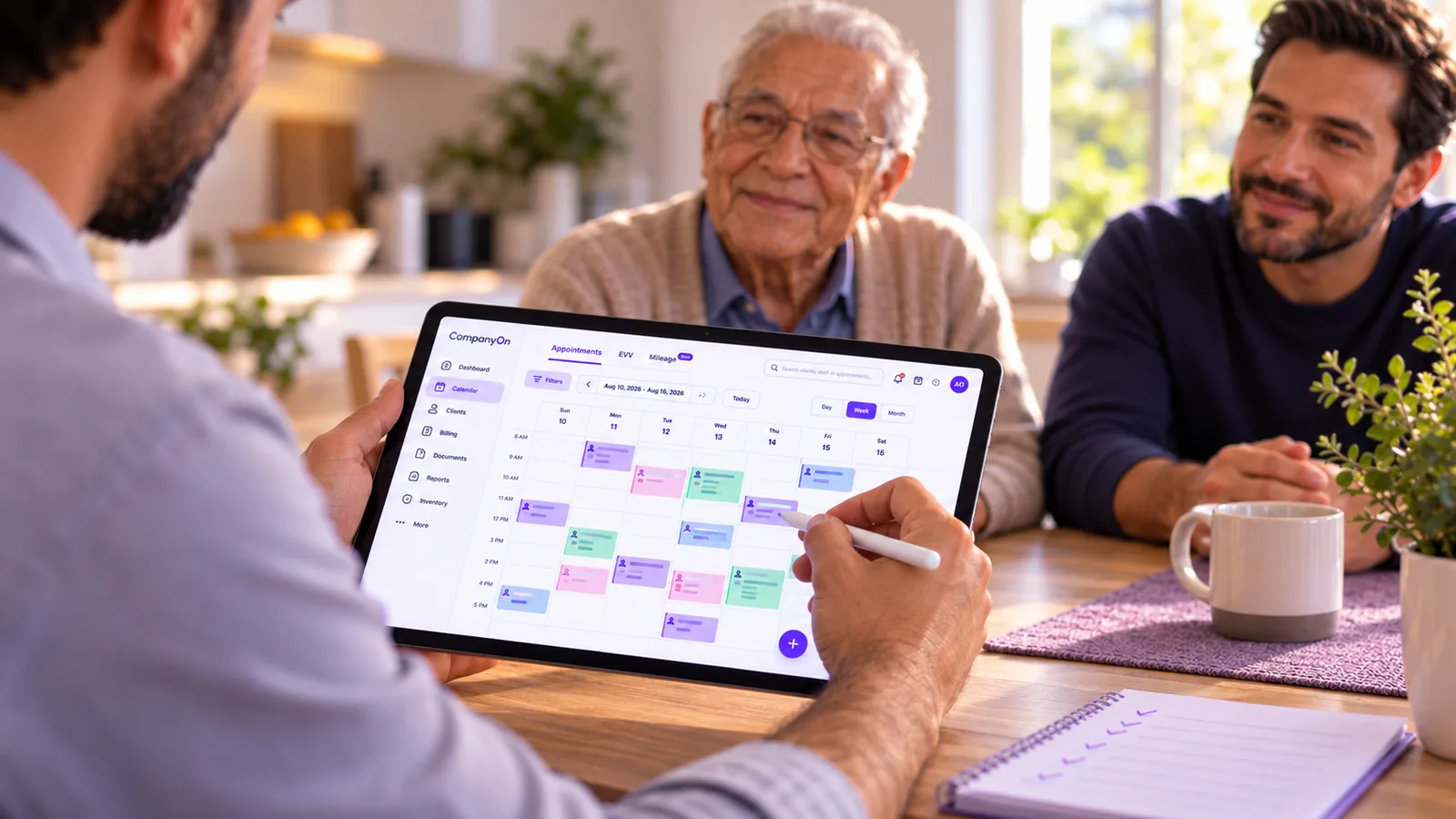
A standard intake form keeps every coordinator consistent and prevents the classic gap: details the family mentioned once that never reached the caregiver. Most agencies capture the following:
| Section | Key details |
|---|---|
| Contact and decision-maker | Client name, address, phone, primary family contact, substitute decision-maker or power of attorney |
| Referral and funding | Referral source, payer type, authorization or approved hours |
| Health summary | Diagnoses, allergies, medications, recent hospital stays, equipment |
| Function and safety | Mobility, transfers, fall history, cognition, home hazards, pets |
| Care needs | Requested tasks, visit frequency and duration, preferred times |
| Preferences | Language, gender preference for caregiver, routines, cultural or dietary needs |
| Consent and privacy | Service agreement, privacy consent, communication preferences |
Keep the form digital so information flows straight into the client record, care plan and schedule instead of being retyped from paper.
Common intake bottlenecks and how to fix them
Missed calls and slow callbacks. Route inquiries to a shared line or rotation, and set a firm callback standard during business hours. A missed inquiry is often a lost client.
Waiting on one person. If only the owner can do assessments, intake stalls whenever they are busy. Train at least two people to assess and draft care plans.
Paperwork after the fact. Collecting signatures, insurance details and consent forms after the first visit creates delays and compliance gaps. Gather them at the assessment.
Retyping data. Every time a coordinator copies intake notes into a schedule, a care plan and a billing record, errors creep in. Enter it once.
No backup caregiver. A first visit that gets cancelled because one caregiver called out sets the worst possible tone. Always name a backup.
How the right software speeds up intake
Getting from first call to first visit in 48 hours is much easier when every step lives in one place. CompanyOn is practice management and EVV software built for home care agencies, trusted by 1K+ practices across Canada & US with a 4.8/5 average rating.
Intake details go straight into the client record and care plan, coordinators schedule the assessment and first visit from the same system, and the assigned caregiver sees the plan in the mobile app before arrival. GPS clock-in and clock-out confirm the first visit happened, visit notes are captured on the caregiver’s phone (even with weak connectivity), and billing and reports pull from the same verified data. Everything runs with HIPAA and PIPEDA aligned security and SSL protection. See how it fits your workflow on our home care agency and EVV solutions page.
Frequently asked questions
What is client intake in home care? Client intake is the process of taking a new client from first inquiry to first visit. It usually includes the first call, an assessment, consent and service agreements, a care plan, caregiver assignment and the first visit.
How long should home care intake take? Many agencies aim to start care within 24 to 72 hours of the first call, depending on urgency and funding approvals. Publicly funded referrals can take longer if authorizations are pending.
What should a home care intake form include? Contact and decision-maker details, referral and funding source, health summary, mobility and safety risks, requested care tasks and schedule, personal preferences, and signed consent and privacy agreements.
Who should do the in-home assessment? Usually a care coordinator, case manager or nurse. If you provide skilled or nursing services, your province, state or funder may require a licensed professional to complete it.
Can intake be done virtually? Parts of it, yes. The first call and many assessment questions can happen by phone or video. An in-person home visit is still valuable for checking safety risks and meeting the client, and some funders require it.
How do we avoid losing details between intake and the first visit? Use a standard digital intake form, enter information once into the client record and care plan, and brief the caregiver through the mobile app before the first visit.
Make your intake the reason families choose you
Families remember how fast and clear you were when they needed help most. A structured 48-hour intake turns that moment into a loyal client. Book a demo to see how CompanyOn connects intake, care plans, scheduling and EVV, or start your free 14-day trial and run your next new client through it.